
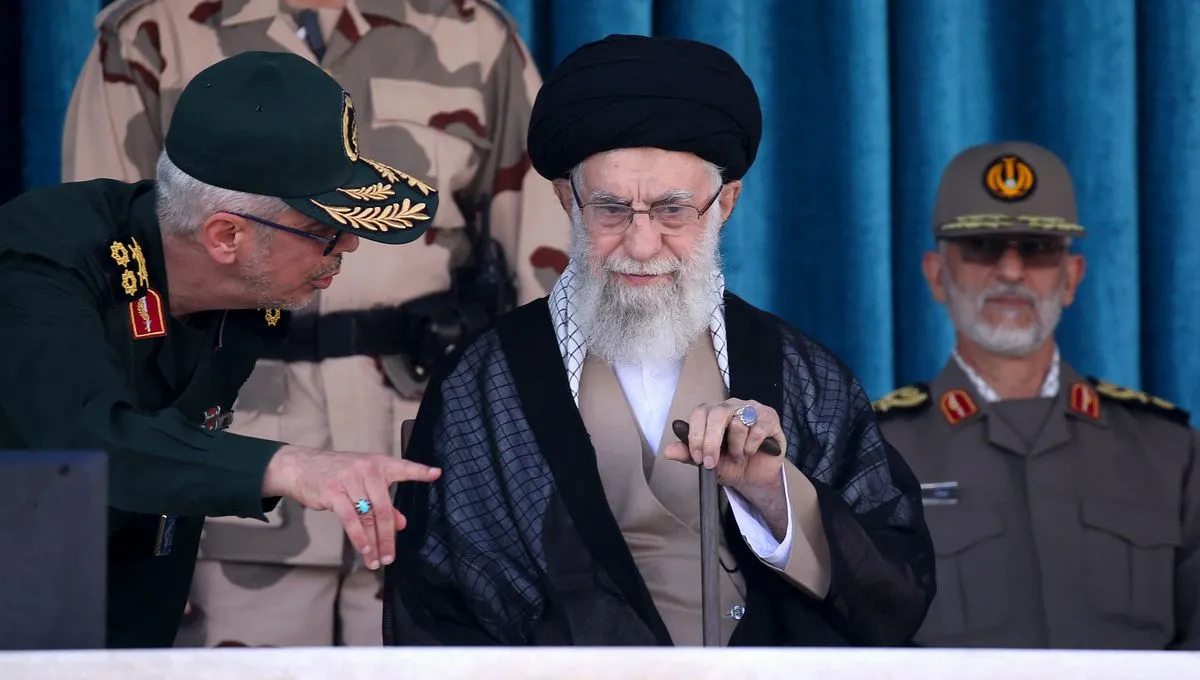
How Khamenei Turns Crisis into Clock Management
Ayatollah Ali Khamenei’s regime is fraying faster than at any time since 1979, yet President Trump touched down in Doha touting a “trade-not-troops” makeover of the Middle East and announcing hundreds of billions in aircraft, LNG and tech deals with Qatar and neighbouring monarchies Reuters. Commerce is welcome, but business alone will not out-maneuver a supreme leader who survives by running out foreign clocks while strangling dissent at home. If the White House really hopes to build an era of prosperity, it must first deny Tehran the luxury of delay—and stand with Iranians who are already shaking the regime’s foundations.
The regime is punching itself
Evidence of panic arrived on March 29, when Tehran police beat and bused pro-regime hijab hard-liners to the city’s outskirts for staging an unauthorised sit-in demanding stricter dress-code enforcement Al Jazeera. Loyalists were treated like insurgents because any public gathering now looks combustible to authorities battered by 40-plus-percent inflation and a currency that has breached one million rials to the dollar euronews. Official media adopted siege language. The Revolutionary Guard paper Javan called further negotiations with Washington a Western “trap” the day after talks collapsed on May 2 Tehran Times; Kayhan counted 182 U.S. sanctions imposed in just 100 days to prove that dialogue is “chloroform in diplomatic form.”
Khamenei’s delay doctrine
Stalling is not drift; it is doctrine. From a decade-long “strategic council” that debated subsidy reform while the central bank printed cash, to a two-year “economic justice dialogue” convened after the 2019 gasoline-price shootings, every crisis is met with a committee and an extension. The nuclear file follows the template. Secretary of State Marco Rubio now insists Tehran must halt long-range-missile work, scrap enrichment above 3.67 percent and defund regional militias Reuters. Khamenei’s reply is a three-note chord—denounce, deflect, drag—while Deputy Foreign Minister Abbas Araghchi tweets in unusually modest English that a “credible agreement is within reach.” The goal is to keep diplomats hoping while the supreme leader keeps the street on lockdown.
It works because foreign pressure crests and fades as U.S. presidents exhaust political capital. Bill Clinton’s late-term sanctions, George W. Bush’s “axis of evil” moment and Barack Obama’s painstaking JCPOA all lost momentum in their final stretch. Trump, midway through his second and last term, is now navigating wars in Europe and Asia, a migrant surge at home and shrinking Hill bandwidth. Tehran’s calculation is straightforward: even “maximum pressure” expires in months.
Europe’s fatigue
Tehran also trades on European hesitation. France’s foreign minister vowed on April 29 to re-impose full U.N. sanctions if talks fail Reuters. Yet every time the snapback fuse is lit, Iranian officials re-install an IAEA camera or hint at a prisoner exchange. EU diplomats, fearful of another refugee tide, pocket the hints and file snapback drafts away.
Thus Khamenei needs two choruses: hard-liners to show Washington compromise is impossible, pragmatists to assure Europe it is inevitable. Together they manufacture a stalemate that buys the only commodity Tehran lacks—time.
Trump’s Doha dilemma
The president’s Gulf tour showcases record aerospace orders, AI partnerships and a proposed “freedom-zone” redevelopment of Gaza The Times. But wealth cannot prosper beside a collapsing theocracy that bankrolls militias from Beirut to Sana’a, nor if Iran’s implosion pushes millions of refugees toward the Gulf. To protect his business blueprint, Mr. Trump has to shorten Tehran’s clock.
A four-point blueprint that matches business with muscle
Washington can still lead—if it moves beyond incremental sanctions and summitry. These four measurable actions would reorder the calendar and the balance sheet.
1. Give the uprising official backing
Bipartisan House Resolution H.Res.166, adopted with 220 co-sponsors last week endorses Iranians’ drive for “a democratic, secular, non-nuclear republic” and condemns regime terror. The president should echo that text; it costs nothing and tells protesters that U.S. policy centers their struggle, not just uranium counts Congress.gov.
2. Globalize the IRGC terror label
The Guard has been a U.S.-designated Foreign Terrorist Organization since 2019. Trump should use his Qatar podium to rally Europe and Gulf partners to replicate the listing—something EU ministers debated but never executed The Washington Institute. Losing access to European insurance, ports and Swift channels would squeeze Guard revenue faster than a dozen new Treasury notices.
3. Snap back U.N. sanctions under Chapter VII
Invoke Resolution 2231’s snapback clause while declaring Iran a threat to international peace under Article 39 of the U.N. Charter. That dual move restores the full pre-JCPOA embargo—missile, arms and enrichment bans—without a new vote that Russia or China can veto JINSA.
4. Stand with Iran’s frontline generation in deeds
- Name and shame shooters: sanction every officer ordering live fire.
- Create a lifeline: fast-track U.S. humanitarian parole and tele-medicine visas for the wounded.
- Fund uncensored media: satellite-beam and VPN-boost Persian-language outlets that publish arrest logs and court sentences; bandwidth is cheaper than a drone.
- Keep score at the U.N.: back a standing mechanism that records every protest killing on the Security Council calendar—making repression as visible as centrifuges.
These steps align perfectly with Trump’s “business-first” rhetoric: they attack the liquidity, legitimacy and timeline on which the regime relies, without another costly war.
The Doha test
Hours before Air Force One touched down, Mr. Trump boasted that Washington and Tehran had “sort of” agreed on nuclear terms; Persian-language dailies dismissed the claim as campaign theater The Times. Their skepticism is the truest gauge of Khamenei’s confidence that stalling will outlast America’s attention span. If the administration wants its Gulf trade architecture to endure, it must deny Tehran the gift of time. The supreme leader has turned that hourglass for 46 years; millions of Iranians have begun to flip it over. Washington should help them, not the man who keeps turning it back.
Jalal Arani is an Iran analyst and writer whose work spans geopolitics, authoritarian systems, religious ideology, and the untold dynamics of resistance—from nuclear secrets to spiritual narratives. His essays aim to reveal the hidden forces shaping Iran and the wider Middle East.