
The Path to Peace Runs Through Tehran’s Streets
The Night the Desert Shook
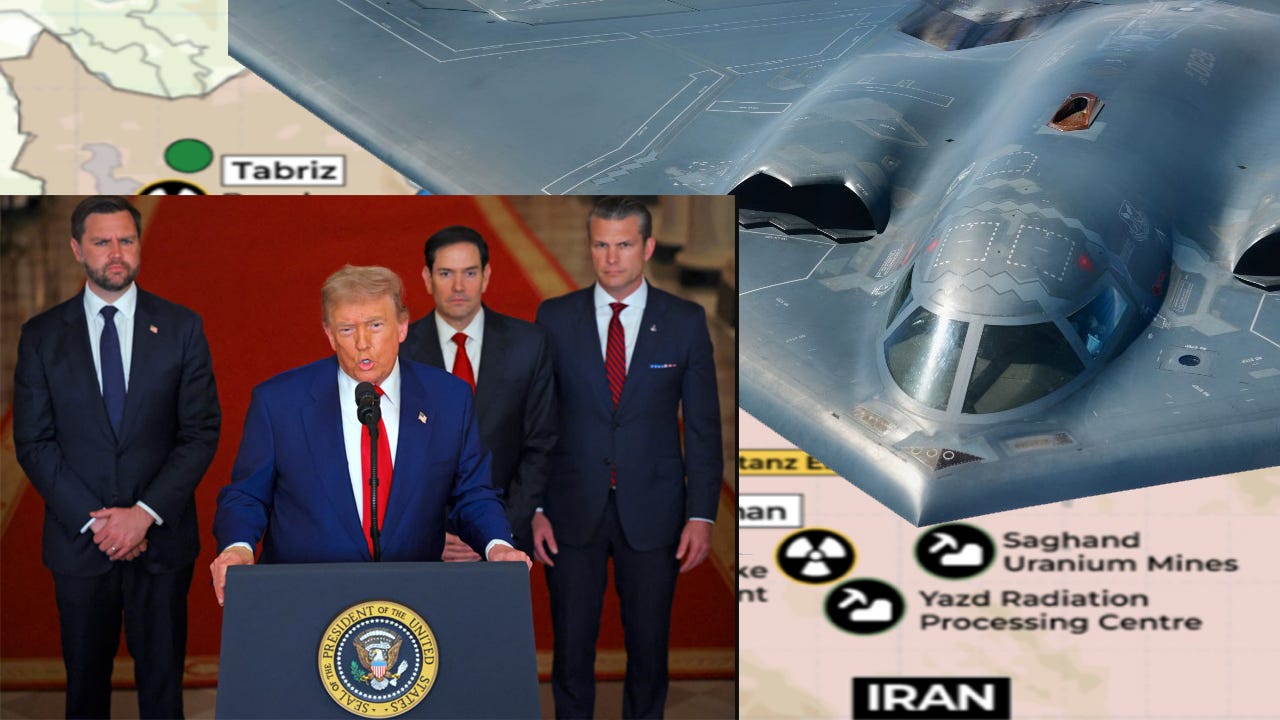
QOM, Iran — In the moonless hours of June 22, two bat-winged B-2 Spirits pierced Iranian airspace, their bellies heavy with America’s most fearsome conventional weapon: the 30,000-pound GBU-57 “Massive Ordnance Penetrator.” Their target: the Fordow enrichment plant, entombed deep beneath a mountain of granite near Qom.
Moments later, Tomahawk cruise missiles—launched from U.S. vessels in the Mediterranean and Persian Gulf—rained down on Natanz and Isfahan.
By dawn, President Trump declared the sites “totally obliterated.” Tehran denounced an “outrageous assault on peaceful installations.” The International Atomic Energy Agency’s remote sensors detected no radiation spikes—hinting Iran had emptied Fordow of fissile material during Israel’s week-long prelude.
In a single night, the U.S. redrew the Middle East’s strategic map.
What the Bombs Achieved — And What They Cannot
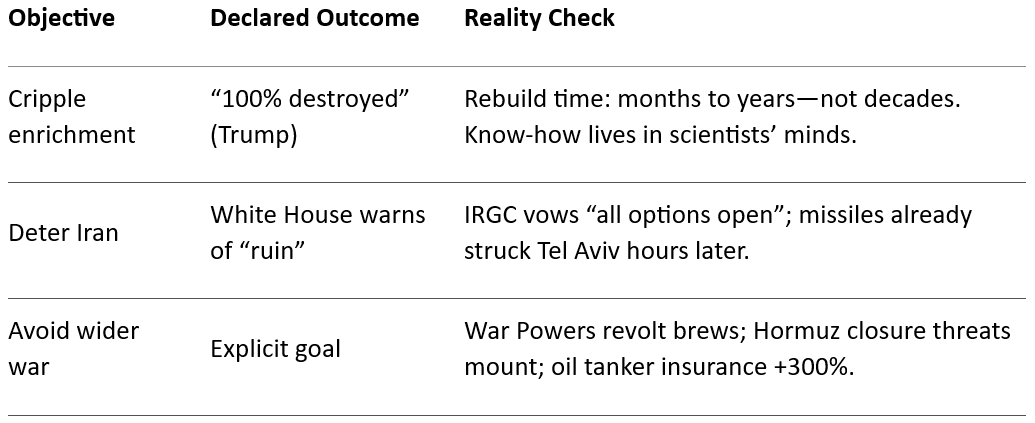
The Unbreakable Core: Airpower shatters concrete—not the DNA of a regime built on repression.
Global Reactions: A Fractured Chessboard
- Washington: Fiercest War Powers Act debate since Libya 2011. Speaker Emmer praised “decisive leadership,” while a bipartisan coalition drafts limits on presidential authority.
- Tehran: Khamenei’s silence signals elite panic. The Revolutionary Guard vows “retaliation with all options on the table.”
- London & Canberra: Guarded support, conditional on diplomatic follow-through.
- UN & EU: Condemnation as a “flagrant violation of international law”; UNSC convened.
- Riyadh & Dubai: Urge restraint; shipping insurance surges +300%.
Four Levers to Bend the Arc Toward Peace
1. Tehran’s Retaliation Calculus
Hard-liners demand Hormuz mining—choking 30% of global oil. But such escalation risks inviting full U.S. retaliation. Expect cyberattacks, proxy rockets, or regional destabilization as face-saving alternatives.
2. Congressional Speed Bumps
War-powers advocates recall Trump’s 2020 veto of Iran AUMF limits. But after decades of “forever wars,” even a veto-proof resolution could signal America’s exhausted appetite for escalation.
3. Emergency Diplomacy
European envoys scramble. One formula floats: *Zero enrichment above 3.67% + full IAEA access* for phased sanctions relief and an Israeli strike freeze. A deal both sides might yet refuse—but the window slams shut hourly.
4. The Overlooked Player: Iran’s People
“Now Khamenei must go… No to appeasement, no to war—yes to regime change by the Iranian people and the Iranian Resistance.”
— Maryam Rajavi, President-elect, NCRI (June 22, 2025)
With youth unemployment at 30% and inflation at 45%, Iran’s streets are a tinderbox. The destruction of Fordow could expose regime vulnerability, ignite protest, and empower an organic uprising steered by the NCRI for regime overthrow—a movement with deep roots inside Iran, a decades-long legacy, and a clear vision: secularism, democracy, gender equality, and a non-nuclear future.
Gaza: The Forgotten Crisis
As global attention pivots to Iran, Gaza’s famine-risk crisis festers. Aid groups warn of imminent starvation for 2.3 million Palestinians. This vacuum fuels Tehran’s proxy network—turning neglect into future rocket salvos.
Scenarios Ahead: Pathways from the Precipice
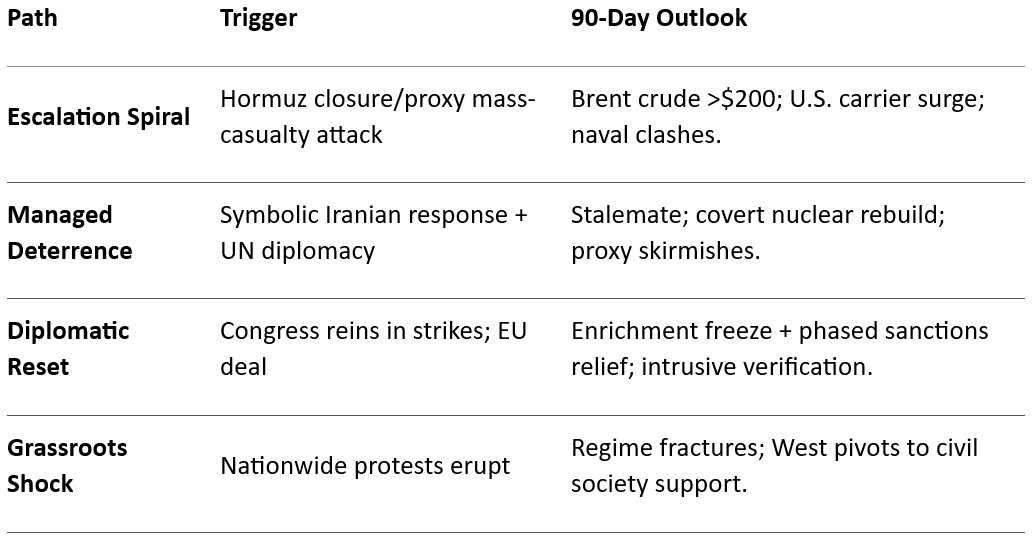
The False Roads: Appeasement or Endless War
The 2015 nuclear deal (JCPOA) collapsed under Tehran’s deceit, cheating, and proxy bloodshed.
Military invasion à la 2003 Iraq would incinerate trillions and inflame militias from Basra to Beirut.
Both paths ignore Tehran’s irreducible truth: Reform is not an option under a regime forged in theocratic violence.
1999. 2009. 2022. Each mass uprising was drowned in blood.
The Third Option: Revolution From Within
Maryam Rajavi’s vision—“a free Iran, democratic, non-nuclear, with religion separate from state”—is not a theory or a Twitter hashtag. It is the strategic imperative, a roadmap:
- Economic Logic: Civil resistance is cheaper than Tomahawks or carrier groups.
- Moral Clarity: Change from within. No “collateral damage” stigma of foreign boots on Persian soil.
- Geopolitical Payoff: A free Iran severs the Tehran-to-Beirut axis, liberates Gulf shipping, and relieves Israel’s security chokehold without U.S. garrisons.
Practical Steps to Catalyze Change
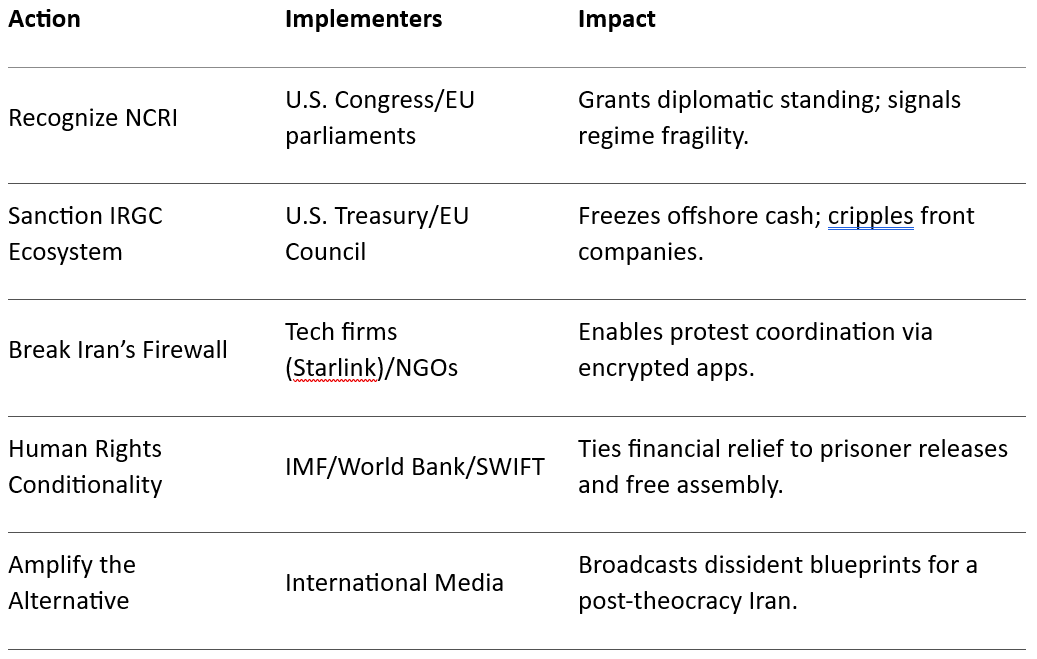
Why Time Favors the Streets
70% of Iranians are under 35. They have seen only tyranny, censorship, and sanctioned misery.
Khamenei’s silence since the strikes betrays the regime’s growing fear.
History shows: When despair meets disciplined opposition, no autocracy is safe, walls fall faster than bunkers.
The Only Door That Opens
Bunker-busters can delay uranium enrichment. They cannot erase a regime’s survival instinct.
Diplomacy can pause hostilities. It cannot cleanse a constitution written in blood.
Only Iran’s 80 million citizens—led by a resistance that mirrors their yearning for liberty—can end this cycle.
The Choice Ahead
We face two roads:
- Fund another forever war, or
- Invest in the people with everything to gain—and nothing left to lose.
As Maryam Rajavi made clear:
“The Third Option is the only strategy that aligns moral courage with strategic realism.”
Khamenei must go—not because Washington wills it, but because Iranians are ready to reclaim their future.
The clock started when the first bomb hit Fordow. The next move is ours.