
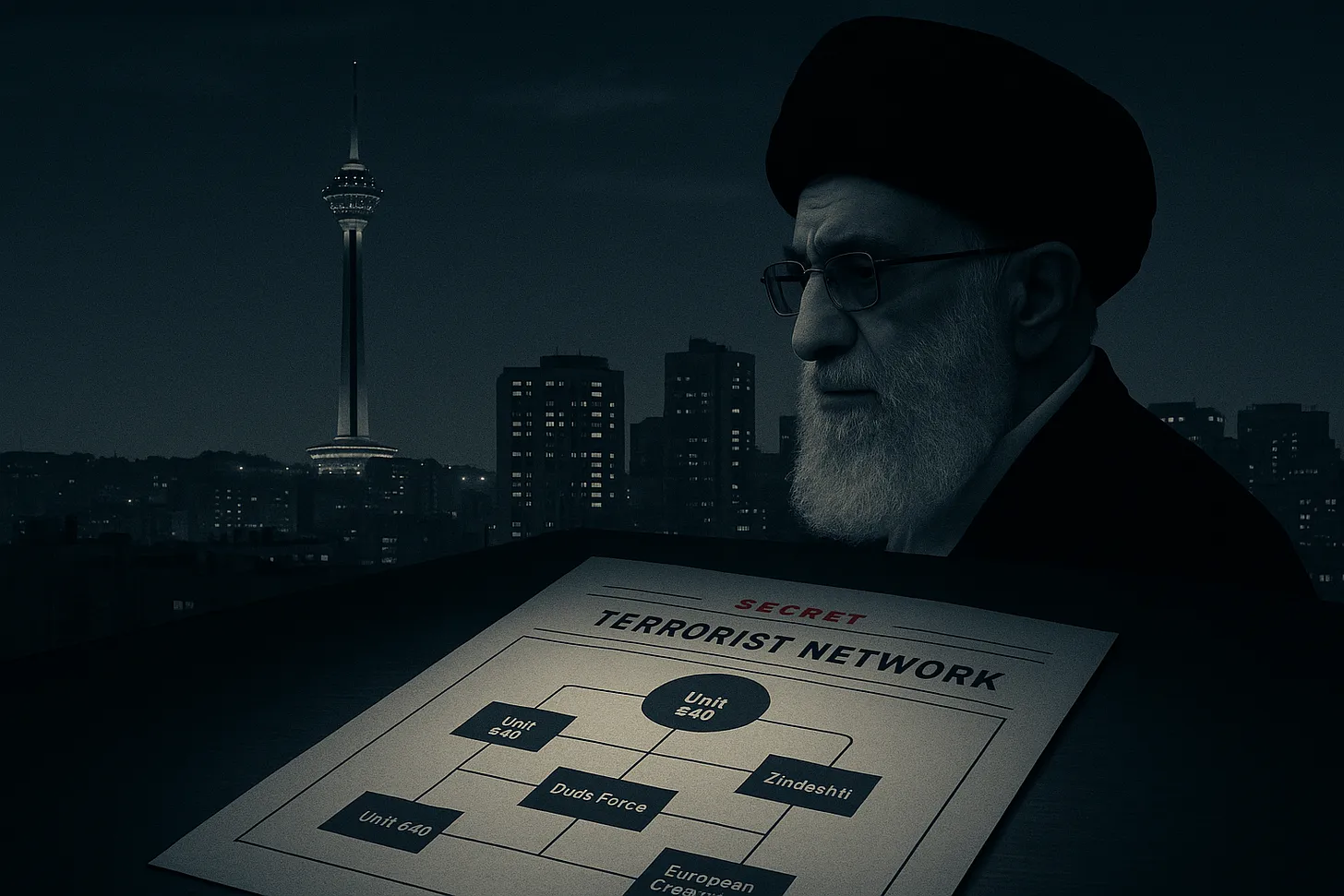
Ayatollah Ali Khamenei, The Supreme Leader’s Global Hit Squad
For decades, Iran’s leadership has relied on terrorism not as an occasional weapon, but as an institutionalized arm of statecraft. From Paris to Washington, its operatives and proxies have targeted dissidents, political figures, and perceived enemies. What is less understood — and far more alarming — is the precision with which this apparatus is structured and the degree to which it operates under the direct authority of Iran’s Supreme Leader, Ali Khamenei.
This is not a loose web of rogue operatives. It is a disciplined, centralized command network designed for global reach, backed by the resources of the state, and increasingly partnered with transnational organized crime.
Terrorism as a Tool of Foreign Policy
Iran’s overseas operations follow a consistent doctrine: terrorism is a formal component of its foreign policy toolkit. Intelligence disclosures, court records, and Western security reports show that Tehran relies on three operational models:
- Direct execution by Iranian agents — carried out by trained intelligence or IRGC operatives, often under diplomatic cover.
- Hybrid operations — blending Iranian agents with foreign mercenaries or dual nationals, allowing partial deniability.
- Complete outsourcing to organized criminal networks — where the regime contracts high-risk operations to transnational gangs, masking Tehran’s fingerprints entirely.
The third model has emerged as the most dangerous in Europe. In November 2023, the attempted assassination of Professor Alejo Vidal-Quadras — a former Vice President of the European Parliament and a vocal critic of Tehran — was executed by the Mocro Mafia, a notorious Dutch-Moroccan drug cartel. Investigators found links between the hit team and the IRGC Quds Force’s Unit 840, which specializes in targeted assassinations abroad.
The Apex: Ali Khamenei’s Personal Command
Western intelligence assessments and recent NCRI-US revelations indicate that Supreme Leader Ali Khamenei personally authorizes high-profile extraterritorial missions. Far from acting as a mere ideological figurehead, Khamenei functions as the regime’s ultimate operations chief. Decisions flow directly from his office to an entity called the Qassem Soleimani Headquarters — a covert command hub within the Ministry of Intelligence and Security (MOIS).
This headquarters is run by Seyyed Yahya Hosseiny Panjaki (also known as Seyyed Yahya Hamidi), the MOIS Deputy Minister and chief of the Counterterrorism Directorate. His remit includes planning missions, coordinating with the IRGC Intelligence Organization, and deploying the Quds Force’s Unit 840. Once greenlit, these operations move from Tehran’s inner circle into the hands of field units — often with the cover and logistical support of Iran’s embassies.
Role of the Ministry of Intelligence and Diplomatic Apparatus
The MOIS’s Foreign Intelligence Directorate, headed by Hossein Safdari, operates intelligence stations inside embassies. These serve dual functions: official diplomatic posts on paper, covert staging grounds in practice. Embassies have been used to pre-position explosives, host operational meetings, and facilitate safe entry and exit for operatives.
The 2018 Villepinte bomb plot in France is the clearest example. Assadollah Assadi, an Iranian diplomat stationed in Vienna, used his diplomatic pouch to smuggle explosives into Europe and directed operatives to attack the NCRI’s annual gathering. The event drew thousands, including Maryam Rajavi, senior U.S. officials, and European dignitaries. Only the swift intervention of German, Belgian and French intelligence prevented mass casualties.
Case Studies and Operational Patterns
The Villepinte case fits a recurring pattern seen in both Europe and the United States:
- Intelligence-led targeting from Tehran.
- Operational command through MOIS or IRGC Intelligence.
- Field execution often via criminal intermediaries.
In the Vidal-Quadras case, Spanish investigators determined that while the shooters were recruited from the Mocro Mafia, the contract was arranged through IRGC channels, with key suspects later traced to safe havens in Iran.
Similarly, MI5 has revealed that between 2022 and 2024, British authorities disrupted at least 15 Iranian plots targeting journalists, dissidents, and Jewish community leaders — many involving local gang members hired to conduct surveillance or attacks. Across the Atlantic, the U.S. Justice Department indicted IRGC operative Shahram Poursafi for plotting the assassination of former National Security Advisor John Bolton, offering $300,000 to a hired hitman.
Terrorism as a Response to Internal Crisis
Iran’s intensification of overseas operations is not merely opportunistic — it’s symptomatic of a regime under pressure. Domestic unrest, such as the 2022, Mahsa Amini, protests, has shaken its legitimacy. Regional setbacks, from weakening influence in Iraq to economic collapse at home, have narrowed its strategic options. In response, Tehran has expanded its overseas operations, targeting not only Iranian dissidents but also Western political figures, in a bid to project strength and intimidate its adversaries.
Links to Global Criminal Networks
The regime’s alliances with organized crime are not incidental. Figures like Naji Sharifi Zindashti, a sanctioned narcotics trafficker and MOIS asset, provide the regime with both operational capacity and deniability. Criminal groups bring pre-existing smuggling routes, money-laundering infrastructure, and an ability to operate in environments where Iranian operatives would draw scrutiny.
The Mocro Mafia’s involvement in the Vidal-Quadras attempt illustrates the tactical advantage: by outsourcing to non-Iranian killers with their own motives and criminal ties, Tehran can muddy attribution, complicating law enforcement and diplomatic responses.
Policy Implications
The fusion of state terrorism with organized crime represents a hybrid threat that is harder to counter than traditional terrorist organizations. It allows Iran to penetrate European and North American security environments with minimal exposure of its own operatives.
This demands a coordinated response:
- Close or restrict Iranian embassies and cultural centers used as operational hubs.
- Designate MOIS and the IRGC in full as terrorist entities in the EU and allied jurisdictions.
- Identify and expel regime operatives and lobbyists operating under cover in the West.
- Target the financial lifelines connecting Tehran to its criminal partners.
- Sanction the leadership, including Khamenei, Panjaki, and Safdari, to directly impact the decision-making chain.
A Covert War in Plain Sight
What emerges from these cases is a picture of a state apparatus that treats terrorism as both foreign policy and survival strategy. This is not an ad-hoc campaign of intimidation — it is a global covert war, run from the highest office in Tehran, sustained by a network of embassies, intelligence operatives, and criminal partners.
For policymakers, understanding the mechanics of this machinery is essential to dismantling it. For the public, grasping the stakes is crucial: these are not distant conflicts — they are operations planned in Tehran, executed on the streets of Europe and the United States.