
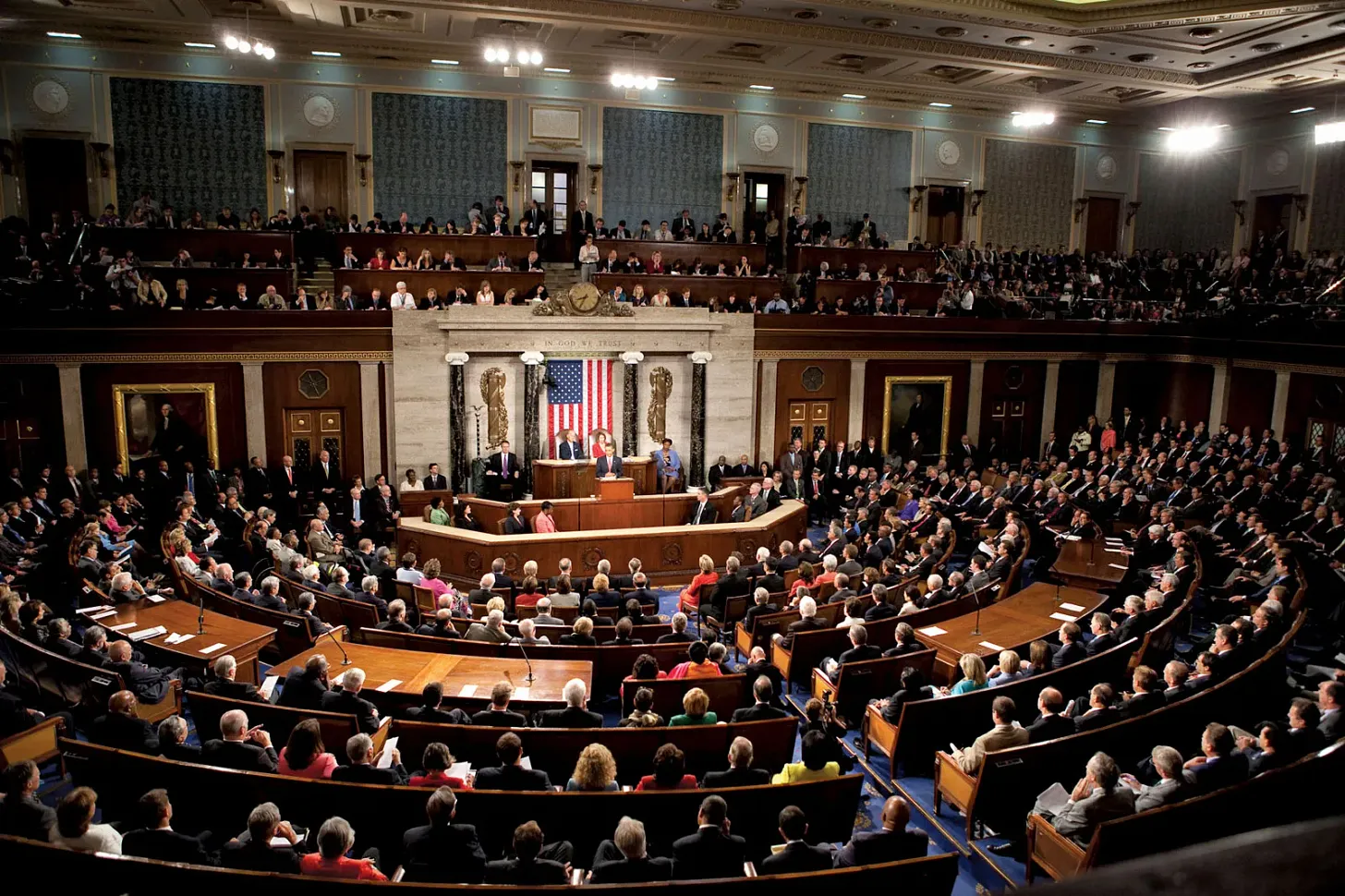
Why H.Res. 166 Matters Now
In a rare display of bipartisan unity, the U.S. House of Representatives has overwhelmingly endorsed House Resolution 166 (H.Res.166), a measure that not only condemns the Iranian regime’s malign activities but also affirms support for the Iranian people’s pursuit of a democratic, secular, and nonnuclear republic. With 220 co-sponsors—including 11 committee chairs, multiple subcommittee leaders, and members across the ideological spectrum—this resolution reflects a growing consensus: the time has come to stand unequivocally with the Iranian people and their vision for a free Iran.
Passed in February 2025 and referred to the House Foreign Affairs Committee, H.Res.166 marks a historic step in U.S. foreign policy toward Iran. It recognizes, in no uncertain terms, that decades of Western attempts to moderate or engage Tehran’s clerical regime have failed. The resolution firmly aligns U.S. congressional support with the Iranian people’s aspirations, not just by condemning the regime’s terrorism, nuclear defiance, and human rights abuses, but by explicitly endorsing the democratic alternative being proposed by Iran’s organized opposition.
https://www.youtube.com/embed/wsLnmIPfnps
This is not a ceremonial declaration. It is a strategic, values-driven mandate that repositions America’s stance on Iran in alignment with principles of self-determination, pluralism, and accountability. It echoes the voices rising from within Iran—protesters risking their lives in the streets, women leading chants against misogyny, youth rejecting dictatorship in all forms—calling not merely for reform but for fundamental, systemic change.
A Broad and Strategic Congressional Consensus
The scope of H.Res. 166’s support is unprecedented for a foreign policy resolution targeting Iran. Among the 220 co-sponsors are 11 committee chairs, leadership figures from six major House committees, and a striking number of members from committees directly responsible for U.S. security and foreign engagement: 21 from Foreign Affairs, 32 from Armed Services, 30 from Appropriations, and 14 from Intelligence. This wide embrace reveals that support for a democratic Iran has matured into a consensus that spans ideology, region, and rank.
Such unity is rare in today’s polarized Washington, but on the question of Iran, it seems conscience and strategy have aligned. Members understand that continued engagement with Tehran has only emboldened a regime whose core identity is rooted in repression, expansionism, and defiance of international norms. The regime’s attempts to export extremism through its proxies in Lebanon, Iraq, Syria, and Yemen are not fringe activities but central to its ideological DNA.
Resonating with the People’s Voice
The heart of the resolution lies in its fidelity to the aspirations voiced by Iranians themselves. The protests of 2018, 2019, and most notably the nationwide uprising of 2022, revealed a seismic shift in Iranian public opinion. These protests were not merely economic in nature; they were existential, targeting the very legitimacy of the ruling system. Their slogans declared opposition to both theocratic rule and any return to monarchical dictatorship, calling instead for a democratic republic.
H.Res. 166 reflects this rejection of all forms of authoritarianism: “The Iranian people have been deprived of their fundamental freedoms, for which reason they oppose any form of authoritarian rule, reject monarchic dictatorship and religious tyranny, as evident in their protest slogans, and seek to determine their destiny, based on their vote, as the sole criteria for political legitimacy.”
This passage is more than rhetorical support. It marks a departure from decades of Western equivocation about the future of Iran. It affirms that legitimacy flows not from inherited thrones or divinely claimed titles but from the ballot box and the will of the people.
A Vision Beyond Opposition: The Ten-Point Plan
Critically, the resolution does not content itself with protest and condemnation. It articulates a vision for the day after. By expressing support for a democratic opposition movement and its Ten-Point Plan, H.Res. 166 moves beyond abstract aspirations. It embraces a concrete framework for a post-theocratic Iran.
This plan—advanced by the National Council of Resistance of Iran (NCRI) under the leadership of Mrs. Maryam Rajavi—commits to universal suffrage, gender equality, separation of religion and state, an end to the death penalty, freedom of expression and assembly, an independent judiciary, and a foreign policy based on peaceful coexistence. It is neither utopian nor vague. It is a structured, attainable roadmap for national renewal.
Mrs. Rajavi’s roadmap, presented in detail before the European Parliament in November 2024, gives voice to the aspirations of millions of Iranians who have taken to the streets and signals the existence of an organized, credible alternative to the current regime. H.Res. 166’s recognition of this plan is not only politically significant but morally consequential: it acknowledges the capacity of Iranians to lead their own democratic transition.
Rejecting the Illusion of Reform
The resolution also functions as an indictment of failed Western policies toward Iran. For too long, the diplomatic default has been to assume that the regime can be induced to moderate its behavior through incentives or appeasement. This illusion has not only failed to curb the regime’s nuclear ambitions or regional interference but has demoralized dissidents inside Iran who see the West engaging with their oppressors.
H.Res. 166 addresses this directly: “The efforts of Western countries over the past 45 years to change the behavior of this regime have failed.” The conclusion is as bold as it is necessary: only through internal change led by the Iranian people, supported by the international community, can the tide of tyranny be reversed.
A Foreign Policy Imperative
Policymakers and analysts alike must understand that this resolution is more than a values statement; it is a strategic realignment. The regime in Tehran is not simply a human rights abuser—it is a global security threat. Its IRGC-led interventions have fueled proxy wars, displaced millions, and destabilized key regions of the Middle East. Its ballistic missile program and uranium enrichment defy multiple UN resolutions. Its cyberattacks and assassination plots have reached European and American soil.
In light of these threats, supporting a legitimate, organized resistance inside Iran is not just morally sound—it is strategically urgent. Empowering voices that advocate democracy, such as those within the NCRI, is the most direct route to neutralizing the regime’s threat without military confrontation. It is a foreign policy that puts people, not dictators, at the center of international engagement.
The Road Ahead
As H.Res. 166 gains traction, the burden now shifts to other governments, international bodies, and civil society. The time for hedging is over. European and UN actors who continue to engage Tehran as a rational actor must reckon with the regime’s track record. The people of Iran have made their demands known. They do not ask for intervention; they ask for recognition, solidarity, and the political space to determine their own destiny.
The U.S. Congress has delivered a clear signal. It is now up to the rest of the democratic world to match that courage.