Watch the narratives being sold—especially the “safe opposition” brand that divides more than it builds.
This analysis draws on direct field synthesis and narrative mapping conducted during the early days of Iran’s latest unrest. It is written for policymakers, journalists, and serious observers seeking to understand not only what is unfolding on the streets—but how global framing may shape the political outcomes that follow.
Last week, on the second day of unrest in Tehran’s Grand Bazaar, a witness described a moment that felt less like a “protest” and more like a threshold.
Around mid-morning, the chant rose sharply—“Close! Close!”—as shutters began to come down. Then, as if the market’s economic reflex had instantly matured into political speech, the slogan shifted into “Death to the Dictator,” moving through the bazaar “like a wave.”
The same witness reported something else that matters for how this moment will be remembered: in the middle of anti-regime chants, a few voices tried to introduce monarchist slogans. The attempt did not spread. A woman reportedly shouted back: “These slogans are theirs—people, don’t be fooled.”
I begin here because this is the dual reality of Iran right now.
Yes, there is a street uprising—deepening, spreading, and becoming more politically explicit by the day. But there is also a parallel conflict, already intense: a struggle over narrative ownership—over who gets to tell the world what Iran is, what Iranians want, and what kind of future is “reasonable.”
And in modern political transitions, the story can decide the settlement.
The street reality: a trigger, then rapid political escalation
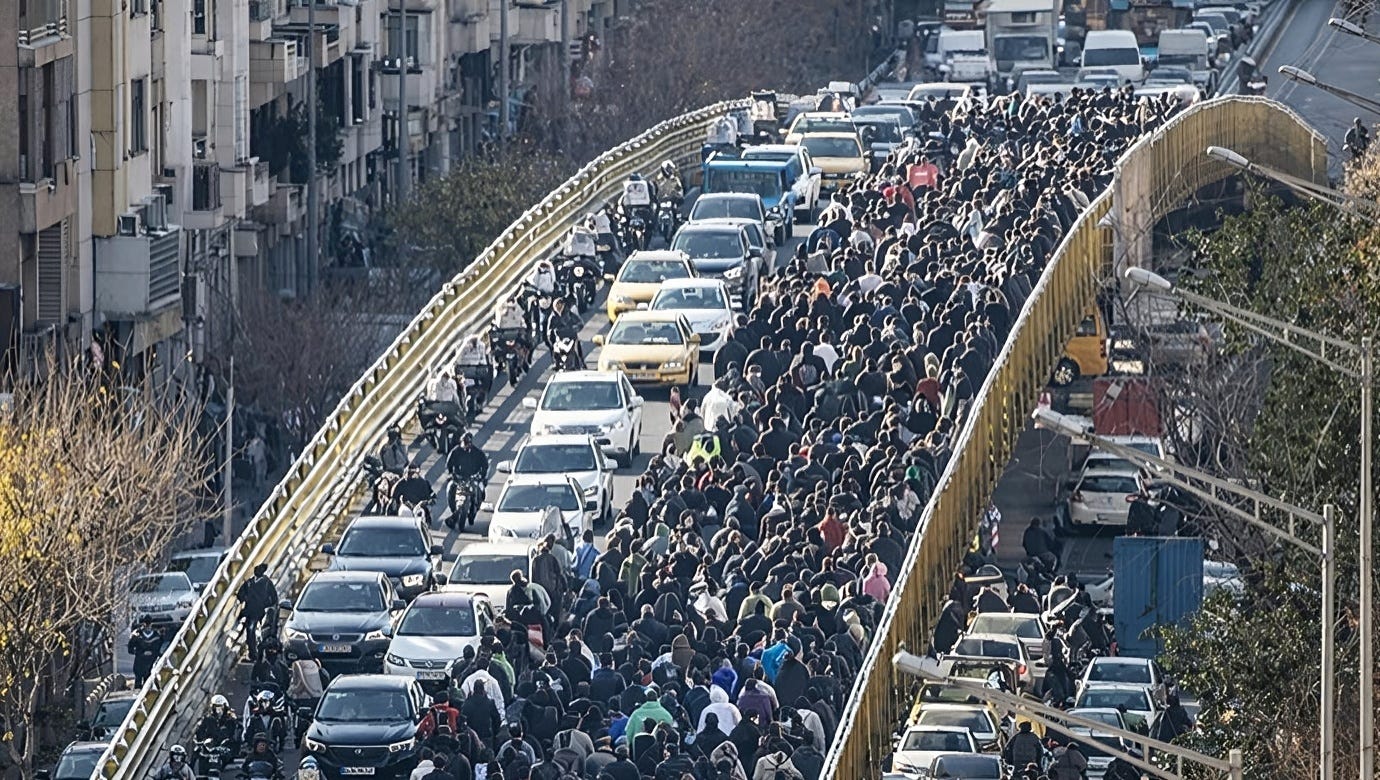
The current wave was triggered by a currency shock and severe livelihood pressure—real pain, felt daily. But direct field reporting from inside Iran we have compiled over the first week adds the granular pattern that policymakers and serious observers often miss: this is not one city flaring. It is a map changing.
A day-nine compilation from inside sources describes “dozens of cities” across multiple provinces experiencing confrontation, with slogans hardening and funerals becoming renewed protest nodes.
The same report logs active protest zones in multiple Tehran neighborhoods—alongside clashes and mobilizations spanning Qom, Lorestan, Kermanshah, Kohgiluyeh & Boyer-Ahmad, Markazi, Alborz, Qazvin, Ilam, Fars, and more.
This distinction matters: the rial’s collapse may be the trigger, but breadth is the signal. When protest becomes geographically distributed, it strains the regime’s ability to contain unrest with localized force. It also invites a deeper shift—what Iranians start recognizing as a shared national condition, not a private hardship.
The root isn’t only economic pain — it’s political captivity
Economic pain explains ignition. It does not fully explain why slogans radicalize, why crowds re-form after dispersal, and why participation can widen even under lethal risk.
Those are the behaviors of a society that increasingly believes the system cannot—or will not—reform itself.
For many Iranians, this is not simply a dispute over prices; it is the resurfacing of a long-buried political demand: to live with dignity under accountable government—an aspiration repeatedly blocked, punished, and postponed across decades.
In that sense, the economy is not a separate “issue.” It is the daily evidence of a deeper grievance: governance without consent, without credible accountability, and without safe avenues for change.
The second front: four narrative power-centers competing to define Iran
As street pressure increases, a second contest becomes decisive: who defines what this uprising “means” to the outside world.
Once a story is woven into global media at scale, it becomes “common belief”—and “common belief” quietly sets the boundaries of policy: who is legitimate, what outcomes are tolerable, and what kind of transition gets treated as “responsible.”
A useful frame is to name four narrative power-centers—not because they are equal in moral standing, but because they are all actively shaping perception.
1) The regime’s Crisis Command Center: survival by demoralization and fragmentation
In Persian, the regime’s crisis apparatus is often described as an “اتاق مدیریت بحران”—a crisis management room. Its objectives are not limited to repression. They include fatigue, confusion, division, and the prevention of any unified alternative.
This is where narrative becomes a weapon: not only to justify crackdowns, but to exhaust the public psychologically, fracture emerging coalitions, and deny the uprising a coherent “endgame.”
2) Regional actors: influence at the margins
Regional states will seek advantage in any post-regime Iran, but they are not the primary authors of the global storyline. They are more often amplifiers and opportunists—working through media ecosystems, contacts, and preferred alignments.
3) Major global powers: a preference for “low-turbulence” transition
Washington, London, and Paris—alongside aligned security interests in the region, including Israel—tend to prefer outcomes that reduce uncertainty: managed transitions, predictable security behavior, and minimized shock to regional and economic systems. This does not require conspiracy; it is structural state behavior.
It is also why the most powerful forms of influence often arrive not as troops, but as recognition, framing, gatekeeping, and “approved” interlocutors—tools that can convert a living revolution into a controllable negotiation.
4) The Iranian people and their vanguards: a liberation narrative
This is the moral center of the moment: Iranians seeking to dismantle a religious authoritarian system, reclaim dignity, and rejoin the world in peace.
But for this fourth force to win, it must achieve what the regime has tried for decades to prevent: durable organization and leadership legitimacy emerging from inside society itself.
Here, a note of caution about “common belief” matters. When major international outlets repeat, wave after wave, that Iran’s opposition is “leaderless” or inherently fragmented, it can become a self-reinforcing frame—especially in a country where effective organization often must remain underground for survival. That doesn’t mean those outlets “lie.” It means their visibility filters, sourcing constraints, and institutional incentives can unintentionally privilege what is easy to see and safe to quote—and undercount what is clandestine, networked, and costly.
Why Reza Pahlavi becomes a narrative pivot — and why the regime quietly benefits
This is where a disciplined analysis must say something many outsiders still don’t fully grasp:
In the regime’s own calculus, Reza Pahlavi is not a credible existential threat.
The threat is not a restoration figure abroad. The threat is an inside-rooted, plural national coalition that can coordinate, persist, and produce credible leadership.
That distinction changes everything about how we interpret the regime’s incentive structure.
Reza Pahlavi is highly visible in diaspora media. But visibility is not the same as capacity—and the regime understands that difference.
What Pahlavi does offer—functionally, regardless of intent—is utility to multiple actors who do not want a fully sovereign, people-led democratic rupture:
- A division instrument: He activates a polarizing axis (monarchy vs. republic; past vs. present) that can splinter the broad coalition required to win.
- A distraction mechanism: He pulls attention outward—to diaspora spectacle and personality politics—away from the hard work of internal organizing and leadership emergence.
- An insurance policy against the “third option”: The more the world internalizes “Islamic Republic vs. Pahlavi,” the more the people-led democratic alternative is erased from global imagination.
Direct street-level observation underscores the risk. The Tehran bazaar eyewitness describes monarchist slogans failing to catch socially, while also alleging that those chanting pro-Pahlavi slogans were treated differently by security forces—“they didn’t touch them,” the witness writes, even as others were beaten or dispersed.
Even if one treats parts of this as perception rather than proven orchestration, the political meaning is serious: many protesters suspect engineered narrative injection inside protest spaces.
A separate analytical report we compiled goes further, arguing that a “royalist” ecosystem has been artificially amplified online—framed as a “safe alternative” that can be exaggerated to divert energy away from a real democratic alternative, and to smear other currents of resistance.
Again, one need not treat every technical claim as settled fact to absorb the strategic logic: the regime gains from any storyline that keeps Iranians divided about the past, so they cannot unite around the future.
This is also why the regime can tactically coexist with external efforts that favor controllable transitions and externally aligned factions. Not because these actors “agree,” but because their outcomes converge on one shared effect: preventing a fully sovereign, people-led democratic breakthrough.
The “third option” is not only a slogan — it has programmatic content
If the world is to avoid the false binary—theocracy versus restoration—it must recognize that the people-led alternative is not merely emotional or spontaneous. It includes, at least in part, organized capacity and political program.
Under intense repression, inside networks rarely advertise themselves; successful underground organization is designed to be hard to map. Still, one cannot honestly discuss the ecosystem of “third option” possibilities without acknowledging that a structured republican alternative has been articulated for years—including Maryam Rajavi’s 10-point framework for a democratic, non-nuclear republic, and claims of decentralized organizing networks associated with the PMOI/MEK.
You do not have to endorse any single movement to notice the analytical point: this is precisely the kind of programmatic clarity and organizational claim that the first three narrative power-centers have incentives to bypass—because it points toward genuine structural change, not a quick “return to calm.” It threatens the managed-transition instinct: the preference to stabilize first and argue about freedom later.
For readers who want the fuller background, I’ve laid out that framework and why it matters here:
Iran Beyond Ayatollahs: A Revolution
I mention this briefly because it sharpens, rather than dilutes, the central argument: the regime’s survival depends less on defeating the street than on preventing the street from recognizing its own real leadership. And few tools serve that purpose more efficiently than a restoration narrative that consumes oxygen while building little capacity.
What makes this historic moment turn in a positive direction
Movements like this are not won by one day of rage. They are won by what persistence produces.
Our inside-Iran synthesis captures three dynamics that matter more than any single headline:
1) Persistence is not repetition — it is maturation
Continuity turns private fear into social courage, spreads hope, deepens shared purpose, and helps people identify who is truly prepared to carry cost for others and for future generations.
2) Organization is the hinge between courage and victory
A nationwide uprising cannot sustain itself without networks—division of labor, coordination, mutual protection, logistics, and disciplined messaging. Organization is also the strongest antidote to sabotage: it blunts demoralization campaigns, reduces the space for diversionary narratives, and forces the regime to confront something it dreads: sustained civic capacity.
3) Geographic spread is a strategic asset
Breadth constrains repression. It stretches security forces, prevents the regime from concentrating violence in a single node, and strengthens legitimacy. Even slogans recorded in the day-six log—“Don’t be afraid, we’re all together”—capture the social logic that makes a movement durable.
Bottom line
If this uprising endures, it will not merely “repeat”—it will evolve. Continuity multiplies participation, sharpens political demands, enables organization, and gradually shifts the balance of power. The regime knows this; so do outside actors who would prefer a controllable transition.
That is why the struggle is already moving onto a second front: not only who can hold the street, but who can define the street. In the regime’s own calculus, a restoration-flavored figurehead is rarely the danger; the danger is an inside-rooted, plural national coalition capable of producing real coordination and real leadership. A narrative that collapses Iran’s future into a familiar binary—the current theocracy versus a return to an inherited past—does not threaten the regime’s survival so much as it threatens the movement’s unity. It dilutes the people-led alternative precisely when it must consolidate.
The central policy question, then, is not whether Iran’s public is suffering—they are. It is whether a people-led democratic rupture can preserve its unity and meaning long enough to generate the organization, leadership, and legitimacy that history demands—while resisting the most dangerous derailment: a global storyline that turns Iran’s freedom struggle into a contest between two authoritarian memories, and in doing so slows the society’s forward movement at the very moment it is trying to break through.