
Hostage Deals and the Betrayal of Iran’s Freedom Movement
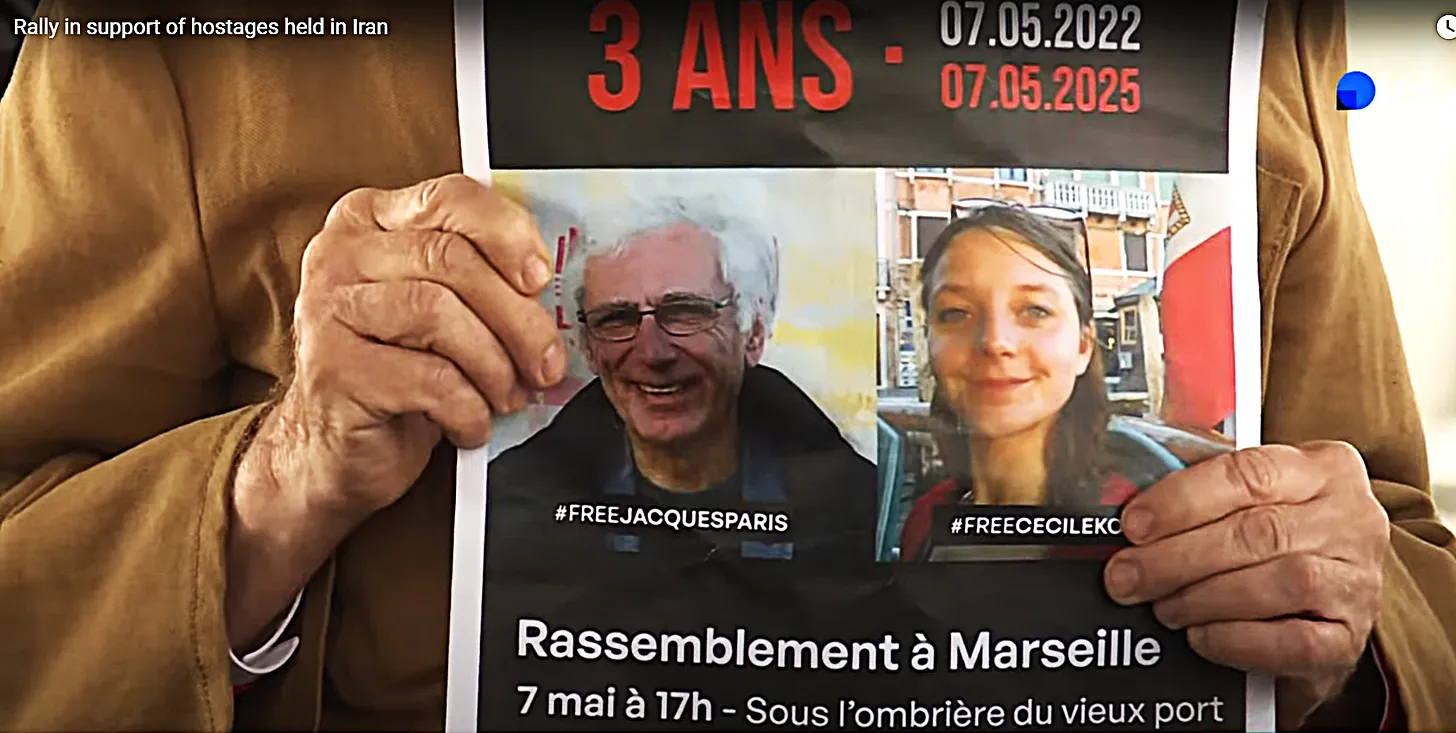
On May 7, rallies erupted across France—from Paris and Lyon to Laval and Lille. Hundreds of citizens gathered with placards reading, “Liberté pour Cécile Kohler et Jacques Paris”, demanding freedom for the two French nationals held hostage in Iran.
As they marked 1,095 days of captivity, their faces haunted the banners and their stories echoed in speeches. For three years, these innocent civilians have languished in Evin Prison’s notorious Section 209, a wing reserved for political prisoners, their lives reduced to bargaining chips in Tehran’s ruthless game of international extortion.
https://www.youtube.com/embed/IuJJHw_Yivk
Yet even as French citizens protest this injustice, their government remains tangled in the very appeasement strategy that enables such hostage diplomacy. Earlier this year, Paris quietly secured the release of another French hostage, Olivier Grondeau, after nearly 900 days of detention. But that diplomatic “victory” came with a price—and it wasn’t paid by the Élysée. It was paid by Iran’s democratic opposition.
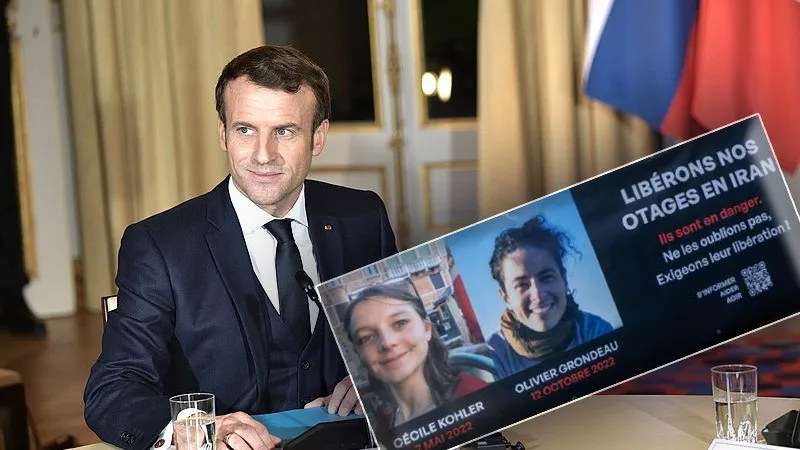
French President Macron’s Hostage ‘Triumph’: A Tehran’s Blackmail Diplomacy
Just days before Grondeau’s release, the French satirical paper Le Canard Enchaîné published a defamatory piece targeting the People’s Mojahedin Organization of Iran (PMOI/MEK) and its president-elect Maryam Rajavi. The article rehashed long-debunked propaganda about “financial misconduct” and “cult-like” behavior—allegations once used by Iran’s intelligence ministry to justify violent crackdowns. The timing of the piece raised immediate suspicions. It followed a troubling pattern: smear campaigns against the PMOI appearing in French media just as a hostage is returned from Tehran.
In June 2024, French authorities raided the offices of the Cima Association near Paris—an organization linked to the PMOI. Iranian state media quickly celebrated the move as a “decisive strike” against so-called terrorists. Not long after, a French national detained in Iran was freed. Tehran’s judiciary chief even boasted about watching the raid “live,” fueling speculation of backchannel cooperation between Paris and the Islamic Republic.
Such episodes are not coincidences. They are symptoms of a deeply flawed Western strategy—one that mistakes capitulation for diplomacy and views resistance to tyranny as a liability rather than a cause for solidarity.
The Cost of Compromise
Cécile Kohler and Jacques Paris were arrested on May 7, 2022, at the end of what was supposed to be a vacation. Iranian authorities accused the couple of “espionage,” though no credible evidence was ever presented. Their families and the French government rightly consider them “state hostages.” Forced to deliver coerced confessions for Iranian state television, the two have endured extended solitary confinement, 24-hour lighting, and near-complete isolation from the outside world. In three years, they have been granted only four consular visits.
Now, amid growing public pressure and calls from their families and former detainees like Olivier Grondeau, Paris has announced its intention to file a complaint against Tehran at the International Court of Justice for violating the hostages’ rights. It is a long-overdue move—but also one that stands in stark contrast to the government’s simultaneous appeasement of the same regime through silence, and worse, complicity in disinformation campaigns against Iranian dissidents.
France cannot credibly claim to fight for the freedom of its citizens while vilifying the very opposition group that has consistently exposed Tehran’s crimes—from its clandestine nuclear program to its global terror networks.
The PMOI and the Disinformation War
Founded in 1965, the PMOI is Iran’s most organized and resilient democratic resistance movement. It was the PMOI that first revealed Iran’s secret nuclear facilities in Natanz and Arak in 2002, triggering global scrutiny and sanctions. Its members have faced decades of mass executions, assassinations, and blacklisting by regimes in both Tehran and Baghdad. Over 100,000 have been killed since 1981. And yet, the PMOI endures.
A 14-year judicial inquiry by France into the PMOI’s finances, which began with a politically motivated raid in 2003 under pressure from Tehran, ended in 2017 with a full exoneration. French judges dismissed all charges and returned $7.2 million in seized assets. No evidence of financial misconduct, coercion, or cult activity was found. Despite this, the myths persist—recycled by lazy journalists or, worse, by those serving geopolitical agendas.
Why? Because the PMOI represents a genuine alternative to the Islamic Republic. Its vision of a secular, democratic Iran—outlined in the 10-point plan of NCRI President-elect Maryam Rajavi—includes gender equality, religious freedom, an end to the death penalty, and a nuclear-free Middle East. For Tehran’s theocracy, such a model is more threatening than any sanction.
Appeasement: A Strategy of Failure
The Islamic Republic has turned hostage-taking into a state industry. As of May 2025, it holds over 20 Western nationals. Tehran’s strategy is brutally effective: seize innocents, extort concessions, and eliminate dissent. The response from Europe—particularly France—has too often been to quietly yield.
In 2018, an Iranian diplomat, Assadollah Assadi, was arrested for orchestrating a bombing plot against a PMOI rally near Paris. Thousands of people, including former prime ministers, U.S. officials, and members of the European Parliament, were in attendance. Assadi was convicted in Belgium and is serving a 20-year sentence. Yet Tehran continues to demand his release—and the West, reluctant to escalate tensions, has not firmly rejected the request.
Each time a Western country caves to blackmail, the regime grows bolder. Each unchallenged propaganda attack on the PMOI emboldens Iran to suppress domestic dissent further. Each trade of truth for expediency undermines the Iranian people’s courage—people who march through the streets of Tehran and Tabriz with bare hands and unbreakable wills, chanting “Zan, Zendegi, Azadi”—Woman, Life, Freedom.
The Iranian people are not asking for Western troops. They are not demanding sanctions for their own sake. They are calling for moral clarity and political consistency. They are asking Europe to stop legitimizing a regime that shoots schoolgirls, poisons students, and hangs dissidents from cranes.
A Moral Reckoning for the West
To his credit, France’s Foreign Minister Jean-Noël Barrot recently condemned Iran’s treatment of Cécile Kohler and Jacques Paris as “torture” and “inhuman.” He urged French citizens to avoid travel to Iran altogether. But words are not enough. Until France aligns its actions with its values—until it ceases enabling Tehran’s repression by scapegoating Iran’s democratic opposition—its condemnation will ring hollow.
Western democracies must learn a fundamental lesson: hostage diplomacy thrives not on Tehran’s strength, but on the West’s weakness. And weakness is not measured by military might or intelligence capabilities, but by moral inconsistency.
France has a proud legacy of liberty, equality, and fraternity. But today, as Iranians rise against tyranny with nothing but courage and conviction, those values are being tested. Will France continue to betray them for the illusion of stability? Or will it finally recognize that appeasement does not prevent conflict—it merely postpones it while deepening its cost?
The Iranian people have already chosen their side. They risk their lives each day to claim a future beyond clerical rule. They deserve allies who match their courage, not governments that barter with their executioners.
As the families of Cécile Kohler and Jacques Paris cry out for justice, let their plight also be a wake-up call. Freedom cannot be won through silence. It must be defended—boldly, publicly, and without apology.
In defense of the voiceless, let truth ignite our resolve—and resistance light the way.