
Nightfall in a Nation of Flickering Lights
Not long after sunset in mid-May, a ribbon of farm trucks stretched for almost a kilometer along a rural road in Golestan Province, engines idling in the dark. The drivers were waiting for the pumps that draw water from the province’s underground aquifers to sputter back to life. Ninety-five percent of Golestan’s drinking and irrigation water depends on those electric pumps; when the grid fails, thirst and crop failure arrive together. This scene, reported by the provincial governor on May 13, would once have been unthinkable in a country that sells roughly a million barrels of oil a day. Yet Golestan is only a microcosm. From Tehran’s crowded high-rise apartments to the date orchards of Khuzestan, Iranians are now clocking the hours of electricity they do not have.
Official Blame, Unofficial Truth
Pressed by reporters, government spokeswoman Fatemeh Mohajerani offered a familiar litany: decades of under-investment, an over-extended distribution network, unprecedented summer heat. Iran, she said on May 13 (23 Ordibehesht 1404), faces a 20-gigawatt shortfall — roughly the output of 13 Hoover Dams. The remedy? Households should keep their air-conditioners set to 25 °C, and the cabinet will “focus on solar.”
Her explanation is tidy, patriotic, and largely beside the point.
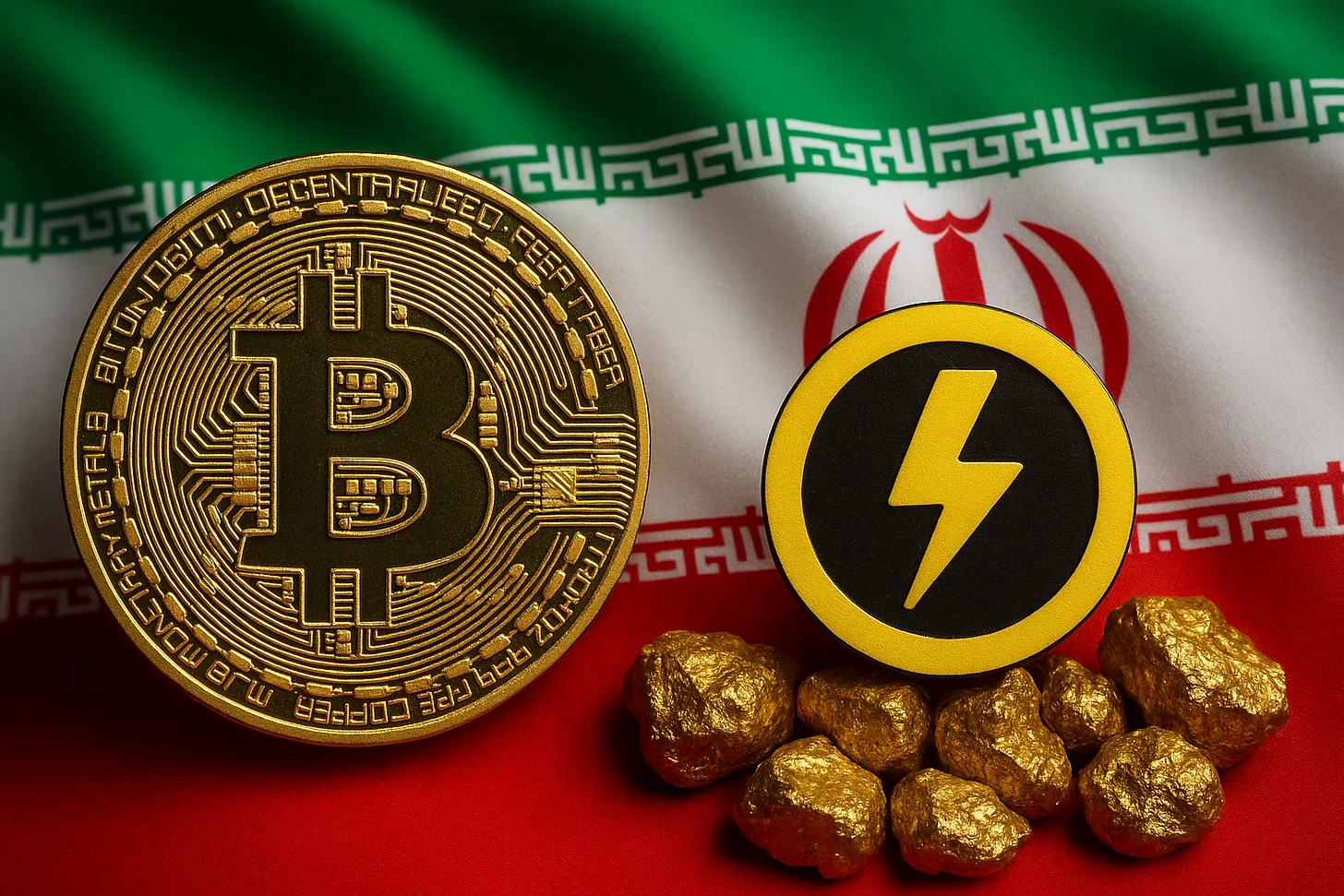
The rolling blackouts that now define an Iranian summer are not a natural by-product of climate change or sanctions-era neglect. They are the foreseeable consequence of a government-protected cryptocurrency cartel that diverts immense amounts of subsidized electricity into the digital minting presses of Bitcoin. The operation is run, directly or through front companies, by the Islamic Revolutionary Guard Corps (IRGC) and the office of Supreme Leader Ali Khamenei. Its purpose is twofold: to replace the hard-currency revenue erased by oil sanctions and to bankroll the machinery of repression that keeps the clerical state in power.
How the Bitcoin Cartel Was Born
The story begins in May 2019, days after the United States quit the 2015 nuclear deal and re-imposed full sanctions on Iranian oil exports. Within weeks, Khamenei authorized the IRGC to strike joint-venture deals with Chinese investors to build industrial-scale crypto “farms.” These are not the hobbyist rigs familiar to Silicon Valley garages. A single complex can house tens of thousands of purpose-built computers, each devouring electricity 24 hours a day in the race to solve Bitcoin’s cryptographic puzzles.
By the end of that first summer, Iran experienced its worst blackouts in a decade. The timing was no coincidence. In July 2020 the Ministry of Industry, Mining and Trade — itself heavily staffed by IRGC alumni — formalized the scheme, issuing cut-rate power contracts and exclusive licenses. Then-Energy Minister Reza Ardakanian boasted that “anyone holding a license may mine cryptocurrency.” What he did not say was that such licenses go almost exclusively to entities tied to the Guard or the Supreme Leader’s beit, or household, and that the power they consume is billed at the same subsidized rates intended for ordinary citizens.
The Physics of Profit
The numbers are staggering. A 2019 study by the Expediency Council’s Strategic Research Institute calculated that minting a single Bitcoin in Iran consumes 2,150 kilowatt-hours, the energy equivalent of 20 barrels of crude oil. When that report was written, Bitcoin hovered around $37,000. Today it trades near $100,000. Every coin produced in an IRGC warehouse now yields almost triple the original windfall. At peak load the crypto mines draw an estimated two gigawatts — enough to power a metropolis the size of Tehran — and bleed an already fragile grid.
Iran’s leaders insist they have no choice: sanctions have throttled oil revenues, cryptocurrency offers a lifeline, and the nation must pull together. But there is another choice — one that does not force schoolchildren to wake at 4:30 a.m. so they can study before the fans go dead, or leave dialysis patients praying that hospital generators hold until grid power returns. That choice would be to end a predatory business model in which public kilowatts are converted into private, border-less wealth.
A State of Complicity and Denial
By February 2025 even the government-aligned news agency Borna admitted that 95 percent of illegal crypto farms simply steal electricity outright. Yet senior officials still lecture citizens about “excessive household use.” In July 2021 the Court of Audit’s own prosecutor shrugged on national television, “We found out later those places were running miners…” The performance oscillates between studied ignorance and deliberate misdirection, but the policy outcome is identical: Parliament fast-tracks laws that criminalize small, independent mining while entrenching the Guard’s monopoly.
The regime’s defenders offer a moral sleight of hand: Isn’t it better, they ask, to generate wealth inside Iran than to leave the country cash-starved and desperate? The question collapses under its own cynicism. The wealth in question accrues to an unaccountable security apparatus, not to the national treasury, let alone the families now forced to choose between refrigeration and lighting after sunset.
Human and Environmental Cost
What disappears from official talking points is the cascading toll. Pumps that supply drinking water shut down. Classroom temperatures soar past 38 °C. Food spoils, air-raid sirens fail, and with every blackout Iran’s carbon footprint grows, because countless households switch on diesel generators. This in a nation already choking on pollution.
The government invokes “national unity” even as it externalizes the pain onto the very people it asks to tighten belts. Young Iranians joke bitterly that the authorities finally found a way to digitize corruption: they no longer stash suitcases of cash, they mint it from electrons.
What the World Can Do
Western policymakers who see Iran’s energy woes as merely a domestic headache misunderstand their leverage. Any conversation on sanctions relief, climate finance, or cross-border electricity swaps should stipulate basic transparency: Who holds the crypto licenses? How much grid capacity is reserved for mining? What percentage of those profits funds the security forces now tasked with crushing dissent?
Cryptocurrency exchanges in Europe and Asia can demand provenance data for coins traced back to Iranian mines. Major mining-equipment manufacturers can refuse sales to IRGC intermediaries. These are not silver bullets, but they raise the cost of state-sponsored plunder.
Turning the Lights Back On
Iran’s blackouts are engineered, not inevitable: end the IRGC’s and the Supreme Leader’s privileged access to subsidized power, and the vaunted 20-gigawatt shortfall would shrink overnight. Reinvest even a fraction of their Bitcoin windfall in the creaking transmission network, and no child would have to memorize lessons by candlelight.
The country enjoys ample sun for solar panels and abundant gas for modern turbines; what it lacks is a leadership willing to place public welfare above the thrill of digital alchemy. Until that changes, living-room bulbs across Iran will keep drawing a grim binary—off or on, darkness for the many, digital gold for the few.
Technical cures will follow only when political ones do, and ordinary Iranians are already laying that groundwork. History seldom sends calendar invites, yet the voltage of public anger is mounting toward the regime’s circuit breakers. When that surge finally trips them, the kilowatts will flow back into the public grid that paid for them—and the first thing they illuminate will be an Iran whose citizens long ago outgrew the rulers who kept them in the dark.
Jalal Arani is an Iran analyst and writer whose work spans geopolitics, authoritarian systems, religious ideology, and the untold dynamics of resistance—from nuclear secrets to spiritual narratives. His essays aim to reveal the hidden forces shaping Iran and the wider Middle East.